
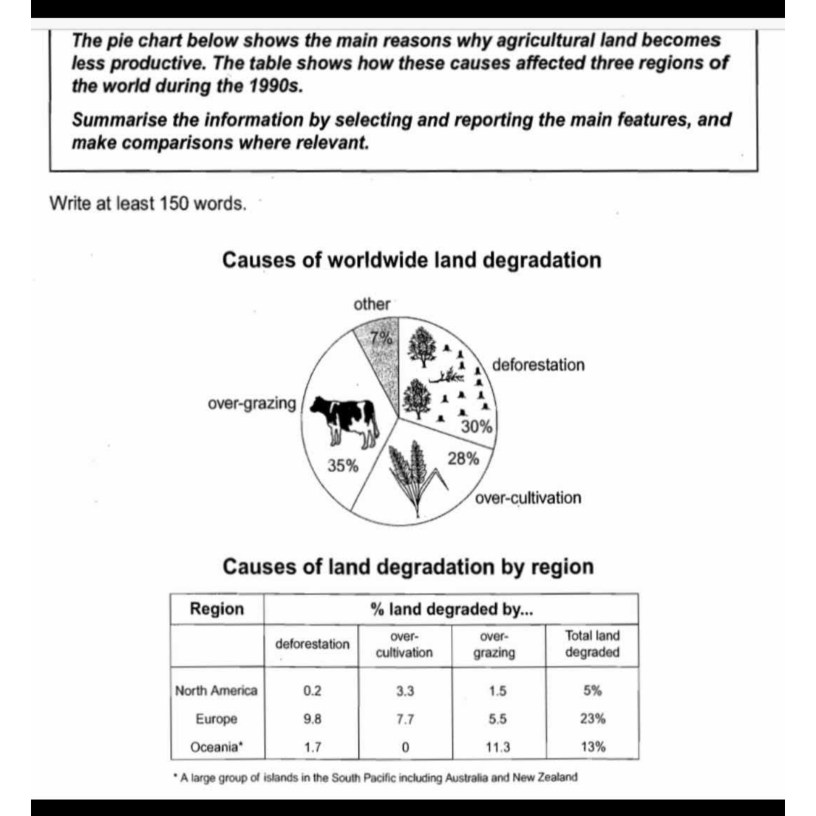
The given pie graph represents the primary reasons for farmland deterioration. The tabular representation, on the other hand, depicts the extent of deterioration that these factors led to in North America, Europe, and Oceania in the 1990s.
In general, all three factors, over-the-limit grazing, reckless cutting of trees, and excessive farming, result in farmland damage to similar extents. Moreover, while Europe suffered the most owing to these in the 1990s, North America had the least impact.
To begin with, overgrazing affects a little more than a third of the farmland on Earth. Deforestation and excessive farming, being not much behind, affect 30% and 28% of the land, respectively. The remaining land is degraded by other factors.
Subsequently, 23% of the total land was harmed in Europe in the 1990s. To this 23%, deforestation, overcultivation, and overgrazing contributed 9.8%, 7.7%, and 5.5%, respectively. Oceania, furthermore, saw 13% of its farmland get affected. Interestingly, almost all of this harm, 11.3%, was caused by overgrazing. Overcultivation played no part, and, as a result, the remaining 1.7% of the land was degraded by deforestation. Finally, overcultivation was the dominant destroyer in North America. It damaged 3.3% of the total 5% degraded. In this region, the corresponding shares of overgrazing and deforestation were 1.5% and 0.2%, respectively.
 IELTS Oggy